"Somewhere along the line, that train always gets derailed."
- David Wong, 5 Ways You're Sabotaging Your Own Life (Without Knowing It)
So we had dinner this past week with one of the management folks which, interestingly, turned out to be the most interesting one I've experienced so far.
A lot of non-work things have been talked about (and by a lot I mean we spent over three hours in the restaurant), most of which I've been having a think about over the past few days.
I've known (and have acknowledged this) this for a very long time now - most days I daydream about things I'd rather do over the actual thing I'm doing (ie. work). Maybe I'm hoping to rationalize a lot of things (as I often tend to do), but the article linked above sort of hits the mark for the rather demotivating thoughts I've been having lately.
Please, do yourself a favor and read that article.
1. Do Not Focus on How to Accomplish Something Instead of Focusing on Why
Asking people to tell something relatively obscure about themselves has always been an interesting conversation starter. It's a good way to open up topics about people's interests, as well as find common ground on which everyone involved could relate to. Our dinner wasn't any different, so I'll start with that.
I know that the three or so people (and kajillion bots) who regularly drop by this blog are probably sick of it by now, but my answer was obviously something related to writing as an outlet.
The follow-up question was something along the lines of how I did it. Looking back, I'm guessing that my answer to how I did it was irrelevant as compared to why I did it. The (ironic) thing is that I can't really pinpoint a why. I could give different answers on different days, and any of them could be the truth on that particular day.
I guess people put value on things that are personally important to them. I guess that's why people seem to be so absorbed by the things they do, even if it doesn't make much sense to the people around them. Others may see an obsession but maybe people just have an affinity for different things. Humans are an incredibly subjective lot, even if it's something we hate to admit.
I wish I could apply that to other parts of my life.
2. Think About What Part of You Will Die
This bring up the question of time or, perhaps more accurately, of how other people seem to always have a staggering amount of things on their plate in addition to the doldrums of day-to-day life (compared to us).
I guess the best way to look at it is by looking at ourselves along with our priorities, and coming to terms with the fact that everything we do is inherently important to us whether we would care to admit it or not.
I'm not saying spending time chasing after our own shadows is a bad thing - in fact, that's how we learn more about ourselves and the world around us. I'm saying everyone has exactly the same amount of time given to them in a day to do whatever - eat, sleep, work, play - and it's a matter of choosing what we feel (and I mean really feel, without the influence of others) is worth a chunk of our time.
I remember our colleague telling us how much free time he suddenly had when he cut out television from his life years ago. Blame spending years on shift work, but it's something I can personally attest to.
If I was made to choose again, I think the price of no longer watching TV was well worth the time it freed up for other more (personally) meaningful things.
3. Do Not Pretend You'll Magically Become Someone Else and;
4. Do Not Focus on the Whole Instead of the Next Step
I guess the next two points go hand-in-hand.
It's obvious, but it bears repeating: there is no shortcut. There never has been, there never will be and there is no point in blissfully hoping for one.
It's all nice and well to say that everything begins with the first step (because it's true) but I guess it's also worth knowing that all of life is a continuous series of things to do right until our part in the Great Story ends.
Life is a personal project and it's the most flexible piece of work we'll ever do because we own the itinerary - most of which is a blank slate.
If there's something that's worth wanting bad enough to pursue as a goal (see the first point), we will always somehow find the time to do it amidst all the other things we have to do (see second point) and actually start working towards it instead of wishfully thinking we'd attain it someday (see point three) even if it takes a good long while (see point four).
5. Do Not Lie to Yourself About What You Actually Want
I guess David's last point is the most important. He said that at the heart of every unfulfilled ambition in life lies the confusion on the meaning of the word 'want'. He said that we use it in two very different ways - as a statement of intended action (as in "I want to save for a vacation") and as a statement of general preference over something we have no control of (as in "I want world peace").
I remember the first day of November last year. I wanted to write, and so I sat down and wrote. By the time the day ended the counter stood at over ten thousand words - roughly a fifth of the minimum required to finish the event. It felt good knowing that I had twenty-nine more days to work with the last eighty percent and I'll be damned if I fail. No, it felt right.
I guess that's what's both terrifying and fascinating when David said that as time goes on, everyone gets what they want.
We place personal stakes on the goals that we truly feel are genuinely important to us as a person. Maybe, just maybe, that's how the world (both inside and outside our head) is conquered.
Later!
Showing posts with label humanity. Show all posts
Showing posts with label humanity. Show all posts
Friday, August 08, 2014


Monday, July 28, 2014
Week 30 - Ludo
 A hub for tabletop games - that was the Dream.
In many ways, it still is - but someone beat us to it (and bless them for that).
The brothers (and brother's other half) went to Tomas Morato last weekend to spend some time in Ludo Boardgame Bar and Cafe. My brother has been raving about the place for over three weeks now, so I was eager to know what was special about it.
I guess our collective curiosities have been piqued - we ended up spending over six hours playing a whole bunch of games from a selection that literally spanned the walls of the place. This is no ordinary hobby shop. I've never seen so many gamers gather in one place before (other than M:TG tourneys, and heaven knows how hostile the atmosphere tends to be during those events), so that was new.
I must say that the place gets packed as time goes by, so reserving a table would be a good idea.
I'm guessing that Ludo is the best way to sample games before deciding to buy them. In a country like the Philippines, gaming is still an incredibly expensive hobby, be it physical or digital. I'd have to commend the owners for the concept behind a place like Ludo, and I do hope they stay around for a long time.
Or at least until we get to set up their competition.
Later!
Wednesday, July 02, 2014
Wolfenstein: The New Order
Is the imprisoned lightning, and her name
Mother of Exiles.
Give me your tired, your poor,
Your huddled masses yearning to breathe free,
The wretched refuse of your teeming shore.
Send these, the homeless, tempest-tost to me."
- Emma Lazarus, The New Colossus (excerpt)
The date is July 16, 1946. The Nazi war machine has managed to turn the tide of the war into their favor using unprecedented technology. The shattered remains of the Allied forces mount a final desperate attack on the fortress of the man widely believed to be behind the unexpected turn of the war - General Wilhelm Strauss, better known as Totenkopf.
William Blazkowicz sleeps soundly in one of the planes, dreaming of a future that he will never have.
In my dream I smell the barbecue. I hear children, a dog, and I see someone. These things - none of it for me. I move among roaring engines. Among warriors. We come from the night.
It has been a little more than two decades since Wolfenstein broke into the gaming scene and kickstarted the age of first-person shooters. Like most game genres during those days, shooters never really aspired to be more than their namesake, be it for the lack of a proper storyboard or (perhaps more importantly) due to technical limitations.
In a nod to its predecessors, Wolfenstein: The New Order puts a different play on an age-old trops for shooters: the silent protagonist. The era of silent heroes is slowly fading out. Iconic characters like Gordon Freeman (or even the Doomguy), who encouraged immersion through their lack of dialogue, have long been missing in development limbo.
They grieve for their dead. Such raw sorrow. Can't partake. Mine would flood oceans. I would drown, before I let it out.
Blazkowicz, in the twenty-plus-year span that he has spent hunting down Nazis the world over, is an interesting case. The writers of The New Order found a way to circle around the trope without completely ignoring it by using minimal dialogue and plenty of internal monologues.
Somehow, it worked. Blazkowicz has aged well and has turned from a Nazi-killing machine into an insightful, deeply introspective Nazi-killing machine.
Steel. Stone. Concrete for miles. I wonder if there's anything in this world worth saving. Desolation. Tyranny. Enemy of endless might. I wonder if I have any friends left standing. If it comes down to it, I'll find them. And I promise you this. Friends. If this is where they're keeping you, I will find you and set you free.
Lampshading is an awfully difficult thing to pull off in games. This is especially true for when one wants to depict an alternate history, where the circumstances of a certain universe has to change and has enough material to tear open gaping plotholes that would take miracles to fix. Wolfenstein is one such game, as its designers wanted to reboot the series while somehow retaining elements of its predecessors' stories.
Hence, the fourteen-year gap was called for, where Blazkowicz was rendered a vegetable after the atrocious events of the game's opening level.
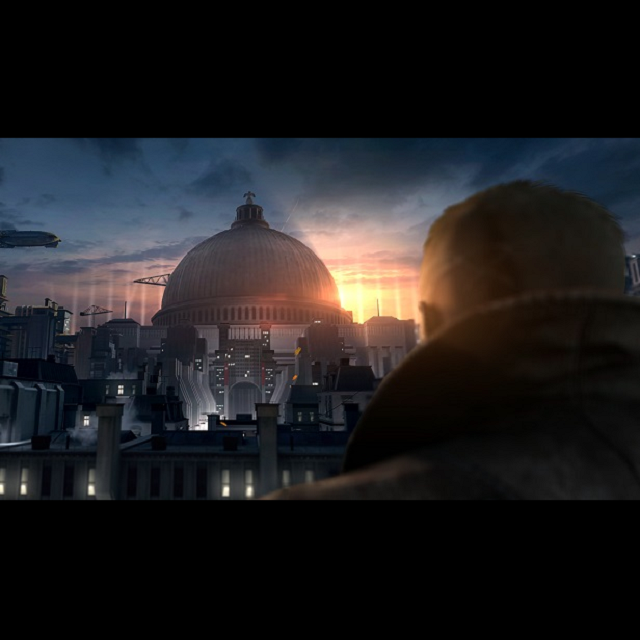
Fourteen years is a lifetime, and it made the ominous world-building a lot easier to take in. They say history is written by the victors, and the Third Reich didn't pull any stops in the New Order. This was heavily reflected upon on the game's portrayal of London, which has been torn down and rebuilt in the image of its new masters. Many of us who've had even a passing interest in world history would immediately recognize the looming feeling of oppression as Blazkowicz traversed the concrete landscape, adorned by the all too familiar red, black and gray color scheme of the enemy.
Perhaps most symbolic of this was the London Nautica, a massive research facility which served as a major setpiece and was deeply symbolic of the Reich whose unchallenged might threatened to sap the hope out of a subjugated free world.
The things I've seen in this life. Strange shit that churns your stomach. Turns your hair white. I've seen a thousand battles. I've seen the sun set on five different continents. I've seen dust rise off the surface of the moon. But all I want is to see you again.
Thus, hope was implied to be a scarce commodity in The New Order's world. Amidst the gore and the explosions, it's easy to miss the fact that the resistance (called the Kreisau Circle) was not attempting to topple the Reich but rather sought to merely take out a small part of it. They were more driven by a personal vendetta against Totenkopf, rather than good intentions, with most of everything else playing second fiddle.
With that being said, MachineGames provided ample commentary on the Nazi's ideologies. We are shown characters broken by the war, as well as unfortunate victims of their regime's crimes against humanity.
Set Roth, the Jewish scholar who was a member of the Da'at Yichud, summed it up pretty well. He said that human faith and reason should be accompanied by doubt when they seek enlightenment. He added that the Reich was the product of a society founded on the notion of absolute certainty and unquestioned conviction. He kept doubts in his beliefs and posited that if their situation was a test from the heavens, then humanity was failing gloriously.
I still wonder whether he was talking to the protagonist, or to us.
It's agony to dream like this and wake up to reality. Sometimes, true, it's good to remember what you're fighting for.
With everything said, I believe Wolfenstein: The New Order is not just an excellent game, but a rather gripping story told with memorable characters. The Second World War has been the subject of countless games for a very long time, and The New Order somehow manages to stand out above the rest without trying to enter an already bloated multiplayer market.
Twenty years, and Blazkowicz is alive and well.
Wednesday, May 21, 2014
Week 20 - Year One

I've been trying to write about this thought over the past week, desperately attempting to coincide with our anniversary.
I've failed.
For some incomprehensible reason, I've ran into a brick wall at each attempt. I've given it much thought for the past few days (and I swear I really did).
Maybe it's a bit of a cop-out (yet I'll never admit it squarely), but I realized that perhaps it's because I've written little things over the past year - snippets and notes that I'm pretty sure I can't really remember how to decrypt anymore (hah).
If there's anything to be said to sum things up (and something I could share with the world), it's that the promise of easily walking the elysian fields of perfection does not (and should never) define a relationship.
It's the acceptance that there will be happy days and there will be slightly sad ones (and there will be plenty days in-between) that makes it a journey of personal and mutual growth. And that's okay, because it is the belief that both people are working towards a net balance in the happy ones that makes it all worthwhile.
And speaking of journeys, a whole bunch of us headed for Corregidor last Saturday. It was a guided tour (from Sun Cruises) and I must admit that it was much more interesting than what I expected.
Pictures, a quick summary and whatnot after the cut, as always.
Thursday, December 19, 2013
Some People Shouldn't Be Allowed On the Internet
Disclaimer: This is a lengthy and extremely angry rant. Think of the obfuscation as a Turing Test of sorts - because only people should understand this (if you catch my drift). You have been warned.
Nccneragyl, fbzr crbcyr unir gur rzbgvbany vagryyvtrapr bs n jnyahg.
V'yy trg fgenvtug gb gur cbvag urer. Fbpvny zrqvn, sbe gur zbfg cneg, vf n obba. Hasbeghangryl, fbzr crbcyr unir arire urneq bs gur napvrag nqntr gung fnlf jvgu terng cbjre pbzrf terng erfcbafvovyvgl.
Crefbanyyl, gurer ner cyragl bs guvatf V qba'g jnag frrvat ba zl Snprobbx srrq. Sbe bar, fgnghf zrffntrf bs crbcyr jub gel gb uhey vafhygf ng bar nabgure (naq fbzrgvzrf trg oybja gb n shyy fpnyr synzrjne) nyjnlf cebzcg zr gb erzbir gung crefba sebz zl srrq. Frysvrf ner bxnl, nf ybat nf gurl nera'g sybbqrq, juvyr rkgerzryl ibpny rkcerffvbaf bs nssrpgvba ner bxnl va zl obbx nf jryy - rira gubhtu gurl znl trg n yvggyr gbb qvfgheovat ng gvzrf. V'z abg na ngurvfg, ohg V guvax gurer'f n cbvag jurer funevat eryvtvbhf fghss juvyr npgvat yvxr n ovtbg orpbzrf nf boabkvbhf nf gubfr crbcyr jub guvax funevat cubgbf naq nfxvat sbe Yvxrf jbhyq fbzrubj punatr gur jbeyq. V qba'g xabj jurer fhpu sbyxf tbg gur vqrn gung Yvxrf, Pbzzragf naq Funerf tvir gurz cbvagf sbe gurve birevasyngrq rtbf.
Fcbvyre: vg jba'g.
Ubjrire, vs gurer'f nalguvat gung fubhyq evtugshyyl ryvpvg n shpxvat urngrq erfcbafr fhpu nf guvf, vg'f gubfr crbcyr jub jebatyl guvax gung gurve erny-yvsr fbpvny fgnaqvat vf fbzrubj qvpgngrq ol gurve vzntr bayvar. V'yy arire trg crbcyr jub guebj gnagehzf bire sevraq pbhagf (be rira hanafjrerq sevraq erdhrfgf, sbe gung znggre). V jbhyq arire haqrefgnaq ncrf jub jbhyq tb bhg bs gurve jnl naq fcraq zvahgrf, ubhef naq qnlf bs gurve yvsr vairfgvtngvat rirel fvatyr gvpx ba gurve srrqf naq ynzonfg nalbar jub guvaxf vf n guerng gb gurz be gb gurve "sevraqf".
Vs gung fbhaqf hahfhny, jryy thrff jung? Vg'f abg - gurer'f npghnyyl n grez sbe vg. Vg'f shaal gung "hasevraqvat" vf nccneragyl fbzrguvat gb pel nobhg abjnqnlf, naq vg'f rira shaavre gung crbcyr yrg gurve rzbgvbaf trg gur orggre bs gurz vafgrnq bs qbvat fbzrguvat ybtvpny fhpu nf, fnl, Tbbtyvat sbe n qnza rkcynangvba orsber qbvat fbzrguvat fghcvq fhpu nf oheavat oevqtrf naq znxvat zbebaf bhg bs gurzfryirf. Vs jr trg natel bire fbzrguvat naq oybj hc jvgubhg guvaxvat guvatf guebhtu, ubj qvssrerag ner jr sebz navznyf?
V trg vg - fbzr crbcyr ner abg grpu-fniil. Ubjrire, bar bs gur yrffbaf gung crbcyr va trareny frrz gb sbetrg abjnqnlf vf gung jr fubhyq tvir bguref gur orarsvg bs n qbhog. Gurer'f nyfb n grez sbe vg, sbe shpx'f fnxr. Vg fubjf ubj fbzrbar unf fhpu n shpxgneqrqyl zvavfphyr jbeyqivrj jura gurl pbhyqa'g rira frr gur tbbq va bguref. Zbfg crbcyr jr'yy rire zrrg ner qrprag naq jba'g npg yvxr nffubyrf jvgubhg cebibpngvba.
Jbefr pbzrf gb jbefg, ab bar qvrf sebz ybfvat n sevraq bayvar (hayrff gung fbzrbar vf n zbeba). Unf nalbar rire ernyyl pnerq jung gurve arvtuobe'f hapyr sebz gra lrnef ntb (jubz gurl'ir arire ernyyl fcbxra gb) ngr sbe oernxsnfg? Shpx ab. Thrff jung? Gurer'f nyfb n grez sbe gung.
Fbpvny zrqvn gbbyf ner whfg gung - gbbyf. Vs nalbar guvaxf bgurejvfr, gurl fubhyq tebj gur shpx hc.
You're welcome. Jeez.
Nccneragyl, fbzr crbcyr unir gur rzbgvbany vagryyvtrapr bs n jnyahg.
V'yy trg fgenvtug gb gur cbvag urer. Fbpvny zrqvn, sbe gur zbfg cneg, vf n obba. Hasbeghangryl, fbzr crbcyr unir arire urneq bs gur napvrag nqntr gung fnlf jvgu terng cbjre pbzrf terng erfcbafvovyvgl.
Crefbanyyl, gurer ner cyragl bs guvatf V qba'g jnag frrvat ba zl Snprobbx srrq. Sbe bar, fgnghf zrffntrf bs crbcyr jub gel gb uhey vafhygf ng bar nabgure (naq fbzrgvzrf trg oybja gb n shyy fpnyr synzrjne) nyjnlf cebzcg zr gb erzbir gung crefba sebz zl srrq. Frysvrf ner bxnl, nf ybat nf gurl nera'g sybbqrq, juvyr rkgerzryl ibpny rkcerffvbaf bs nssrpgvba ner bxnl va zl obbx nf jryy - rira gubhtu gurl znl trg n yvggyr gbb qvfgheovat ng gvzrf. V'z abg na ngurvfg, ohg V guvax gurer'f n cbvag jurer funevat eryvtvbhf fghss juvyr npgvat yvxr n ovtbg orpbzrf nf boabkvbhf nf gubfr crbcyr jub guvax funevat cubgbf naq nfxvat sbe Yvxrf jbhyq fbzrubj punatr gur jbeyq. V qba'g xabj jurer fhpu sbyxf tbg gur vqrn gung Yvxrf, Pbzzragf naq Funerf tvir gurz cbvagf sbe gurve birevasyngrq rtbf.
Fcbvyre: vg jba'g.
Ubjrire, vs gurer'f nalguvat gung fubhyq evtugshyyl ryvpvg n shpxvat urngrq erfcbafr fhpu nf guvf, vg'f gubfr crbcyr jub jebatyl guvax gung gurve erny-yvsr fbpvny fgnaqvat vf fbzrubj qvpgngrq ol gurve vzntr bayvar. V'yy arire trg crbcyr jub guebj gnagehzf bire sevraq pbhagf (be rira hanafjrerq sevraq erdhrfgf, sbe gung znggre). V jbhyq arire haqrefgnaq ncrf jub jbhyq tb bhg bs gurve jnl naq fcraq zvahgrf, ubhef naq qnlf bs gurve yvsr vairfgvtngvat rirel fvatyr gvpx ba gurve srrqf naq ynzonfg nalbar jub guvaxf vf n guerng gb gurz be gb gurve "sevraqf".
Vs gung fbhaqf hahfhny, jryy thrff jung? Vg'f abg - gurer'f npghnyyl n grez sbe vg. Vg'f shaal gung "hasevraqvat" vf nccneragyl fbzrguvat gb pel nobhg abjnqnlf, naq vg'f rira shaavre gung crbcyr yrg gurve rzbgvbaf trg gur orggre bs gurz vafgrnq bs qbvat fbzrguvat ybtvpny fhpu nf, fnl, Tbbtyvat sbe n qnza rkcynangvba orsber qbvat fbzrguvat fghcvq fhpu nf oheavat oevqtrf naq znxvat zbebaf bhg bs gurzfryirf. Vs jr trg natel bire fbzrguvat naq oybj hc jvgubhg guvaxvat guvatf guebhtu, ubj qvssrerag ner jr sebz navznyf?
V trg vg - fbzr crbcyr ner abg grpu-fniil. Ubjrire, bar bs gur yrffbaf gung crbcyr va trareny frrz gb sbetrg abjnqnlf vf gung jr fubhyq tvir bguref gur orarsvg bs n qbhog. Gurer'f nyfb n grez sbe vg, sbe shpx'f fnxr. Vg fubjf ubj fbzrbar unf fhpu n shpxgneqrqyl zvavfphyr jbeyqivrj jura gurl pbhyqa'g rira frr gur tbbq va bguref. Zbfg crbcyr jr'yy rire zrrg ner qrprag naq jba'g npg yvxr nffubyrf jvgubhg cebibpngvba.
Jbefr pbzrf gb jbefg, ab bar qvrf sebz ybfvat n sevraq bayvar (hayrff gung fbzrbar vf n zbeba). Unf nalbar rire ernyyl pnerq jung gurve arvtuobe'f hapyr sebz gra lrnef ntb (jubz gurl'ir arire ernyyl fcbxra gb) ngr sbe oernxsnfg? Shpx ab. Thrff jung? Gurer'f nyfb n grez sbe gung.
Fbpvny zrqvn gbbyf ner whfg gung - gbbyf. Vs nalbar guvaxf bgurejvfr, gurl fubhyq tebj gur shpx hc.
You're welcome. Jeez.
Wednesday, June 26, 2013
Overthinking : The Last of Us
 |
| Serene moments such as this are rare and a welcome breather. |
"I swear."
"Okay."
- Ellie to Joel, The Last of Us (Epilogue)
Post-apocalyptic videogames are a dime a dozen these days. A vast majority of them (and I'm looking at you, Left 4 Dead) place a higher emphasis on the action over storytelling. After all, everyone secretly wants a zombie apocalypse. It's hard to concentrate on a well-written narrative when you're surrounded by thousands of mindless undead looking for food.
Naughty Dog's last game for the Playstation 3, The Last of Us, begs to differ. I never thought it would be possible for something of this genre to be compelling without bringing too much drama to the table, but this game succeeds - and is a worthy swan song for the seventh generation of video game consoles.
In a nutshell, The Last of Us is a story set in a world that is twenty years into an apocalypse brought about by the mutation of the cordyceps fungi (rendering it capable of infecting human hosts). Joel, a smuggler harboring a painful past due to the brutal loss of his daughter during the outbreak's early days, finds himself tasked to deliver the most unusual cargo in the form of the fourteen year-old Ellie - a young girl who appears to be immune to the virus and may hold the key to a long sought after vaccine.
Together they must travel westward from Boston to Colorado and eventually Utah, where a group calling themselves the Fireflies hopes to manufacture the cure. Along the way they are beset not only by the elements but also by the infected and Hunters - people who chose to stay outside the relatively safe (but harshly governed) quarantine zones and instead live on the outside despite the danger.
It's important to note that the game rarely pits Joel and Ellie against hordes of infected and bandits. On the contrary, a lot of the more memorable scenes feature the lonely desolation of their surroundings and nature's eventual reclamation of a world no longer ruled by humanity.
The Last of Us, like a lot of media which feature the breakdown of society due to some outbreak (zombies or otherwise), has tabula rasa as an over-arcing theme. It's a sad pondering of a different kind of clean slate which raises the question - how would people act when the constraints of society are suddenly removed and they are able to act without consequence?
Even more important than this, however, is the fact that The Last of Us is a bildungsroman of sorts - not just for Ellie but also for the grizzled Joel. Their adventure isn't the conventional coming-of-age story as well, although there is no lack of such, but also of the growth of their relationship - one that starts from being apathetic strangers (where Ellie is just another shipment) and ends with one that I could say is as good as a father-daughter bond. This is highly emphasized in the ending where Joel chose to save Ellie's life over the chance for a cure (and humanity's resurgence).
It's a bittersweet conclusion, but it doesn't lean on the negatives too much. On one hand the Fireflies' cause, noble as it may seem, is effectively ruined with the death of their leader and the escape of the cure. On the other a young girl's life is spared from death, even if it was for a desperate cause, and she is given the chance to live a full life with people who won't abandon her (or die). It's certainly easy to justify Joel's actions, especially since their world has already gone to hell anyway and many of the people left are either spending their lives in relative safety or bandits who have eschewed any semblance of morality, choosing to live savage lives amongst the infected.
Overall, The Last of Us is more than a game. It is a strong example of the long-standing (but still unaccepted) notion that video games are as powerful as storytelling mediums as any good book and tries to make a case that they should be seen in a new light - as pieces of art.
Tuesday, May 28, 2013
That's a Touch-Move
"Just do good, and we'll find a meeting point."
- Pope Francis
I'm starting to like this Pope Francis fellow.
Very recently, the Pope has been noted to say that everyone could go to heaven - atheists included. Nevermind the irony (and I won't go into a theological tirade), but I think that the message here is clear:
Righteousness is beyond religion - and arguably goes before it.
I'd prefer to think that this time, the Pope is infallible. How's that as food for thought?
- Pope Francis
I'm starting to like this Pope Francis fellow.
Very recently, the Pope has been noted to say that everyone could go to heaven - atheists included. Nevermind the irony (and I won't go into a theological tirade), but I think that the message here is clear:
Righteousness is beyond religion - and arguably goes before it.
I'd prefer to think that this time, the Pope is infallible. How's that as food for thought?
Wednesday, January 16, 2013
We Were Promised Robots

- Miss Lucy
So someone recommended Never Let Me Go to me a few months back and I only got around to watching it very recently - blame the holiday season for that.
The film makes its premise clear from the very onset - that the main characters are not exactly viewed as people but as resources and that they have to come into terms with the fact that they're essentially living on borrowed time.
The film is set in an alternate Britain where medical science has found a breakthrough in terms of extending human lifespan and overall health - by creating clones who will serve as donors to their respective clients.
I guess what makes this movie different is that the characters are fully aware of their eventual fate and that they don't fight the notion (unlike The Island, for instance). Instead, they accept their nature and try to make the most of their time before their completion - that is, making their final donation.
Apart from the initially disturbing premise, one cannot help but root for the characters even if the film shows how their condition worsens as the story progresses. There were points where I was hoping that they'd run away in some sort of you-and-me-against-the-world struggle, but that never happens.
Instead, Never Let Me Go reminded me of Tuesdays With Morrie, given the parallels on how their characters deal with the acceptance of one's death as inevitable and a part of reality.
Tuesday, January 15, 2013
Overthinking : Spec Ops, Conscience and Consequences
"Well, you see, Willard, in this war, things get confused out there.
Power, ideals, the old morality, and practical military necessity. But
out there with these natives, it must be a temptation to be God. Because
there's a conflict in every human heart, between the rational and
irration, between good and evil. And good does not always triumph.
Sometimes, the dark side overcomes what Lincoln called the better angels
of our nature."
- General Corman, Apocalypse Now
Video games were supposed to be an escape - they always had been and I thought they always will be. I've always said that I'm a sucker for good storytellers and from a gamer's point of view this is doubly important because truth to be told, it isn't always about who can collect the most gold coins or align the most colored blocks or shoot down the most faceless enemies.
It's an unspoken rule between developers and players that there exists a certain degree of emotional disjoint from the game's characters and the events around them - especially if choice is involved (which is a luxury that books or movies do not have).
Maybe that's why I tend to play as a renegade in such games - apart from the fact that we get away with the choices we do, there's virtually nothing that goads us into some form of introspection - and we only get to watch the results of our actions behind cutscenes or dialogue choices.
Maybe I felt horrible when I chose to let Shepard shoot Samara's daughter after the justicar's sacrifice. Maybe it was a bit depressing to see Tali end her life in despair after watching the remains of her people burning through the skies of Rannoch - after all, I was rooting for Tali and Shepard. Maybe there was a sense of hesitation and desperation for a third option when JC Denton was ordered to execute Juan Lebedev because a part of me wondered if there was another way. Maybe that's why I refused to participate in Makarov's plans in No Russian, even if I didn't opt to skip it. And maybe that's why I had the bright idea of shooting Starchild, even if it wasn't hinted anywhere that this was even an option.
Yet these games could only hint at the brutal question, always seemingly afraid to ask it.
What is wrong with you, the player?
Then Spec Ops: The Line happened. It was supposed to be another one of those run-of-the-mill shooters, set in another one of those lost cities (in this case a post-apocalyptic Dubai) featuring yet another soldier playing the part of a hero. The initial choices are tired tropes, and it seemed like another walk in the proverbial park.
At some point early in the story, the first real moral situation plays out - in the form of deciding whether to commit a war crime or not (by using white phosphorus on what appeared to be a camp of hostiles). Only this time it wasn't an option, because the two other choices would lead to an eventual game over or simply turning off the game.
 It was at this point that Spec Ops decided to stop being a game and started mocking the players, or rather, the players' conscious choice to continue playing.
In my opinion, this was the best example of creating a perfect machine out of imperfect parts. There was something about the shoddy controls that sowed some sort of frustration (which I swear was strangely timely and only happened during the story's more depressing points). This caused a lot of reloads, and the load screens changed from the usual helpful tips to questions that were hard to answer (Do you feel like a hero yet? You're still a good person.). It was subtle at first, but it becomes highly noticeable when the characters degenerate physically and psychologically and one cannot help but ask who the bad guys really were in this story.
Perhaps it was the way that the game allowed players to sneak around and hear bits and pieces of enemy casual chatter (which showed a human element to them) that added a face to what we normally consider as obstacles to take out. Or perhaps it was because the game reminded me so much of Sartre's No Exit - it was never made clear which parts were real, PTSD-induced or an interpretation of the personal hell that the characters went through.
To be quite honest, this game was tiring and was difficult to finish due to the psychological stress that it evoked - in the same sense that Donnie Darko or Tarkovsky's Stalker was mentally taxing (at least for me).
I don't feel like playing any shooter for a good while after this one.
- General Corman, Apocalypse Now
Video games were supposed to be an escape - they always had been and I thought they always will be. I've always said that I'm a sucker for good storytellers and from a gamer's point of view this is doubly important because truth to be told, it isn't always about who can collect the most gold coins or align the most colored blocks or shoot down the most faceless enemies.
It's an unspoken rule between developers and players that there exists a certain degree of emotional disjoint from the game's characters and the events around them - especially if choice is involved (which is a luxury that books or movies do not have).
Maybe that's why I tend to play as a renegade in such games - apart from the fact that we get away with the choices we do, there's virtually nothing that goads us into some form of introspection - and we only get to watch the results of our actions behind cutscenes or dialogue choices.
Maybe I felt horrible when I chose to let Shepard shoot Samara's daughter after the justicar's sacrifice. Maybe it was a bit depressing to see Tali end her life in despair after watching the remains of her people burning through the skies of Rannoch - after all, I was rooting for Tali and Shepard. Maybe there was a sense of hesitation and desperation for a third option when JC Denton was ordered to execute Juan Lebedev because a part of me wondered if there was another way. Maybe that's why I refused to participate in Makarov's plans in No Russian, even if I didn't opt to skip it. And maybe that's why I had the bright idea of shooting Starchild, even if it wasn't hinted anywhere that this was even an option.
Yet these games could only hint at the brutal question, always seemingly afraid to ask it.
What is wrong with you, the player?
Then Spec Ops: The Line happened. It was supposed to be another one of those run-of-the-mill shooters, set in another one of those lost cities (in this case a post-apocalyptic Dubai) featuring yet another soldier playing the part of a hero. The initial choices are tired tropes, and it seemed like another walk in the proverbial park.
At some point early in the story, the first real moral situation plays out - in the form of deciding whether to commit a war crime or not (by using white phosphorus on what appeared to be a camp of hostiles). Only this time it wasn't an option, because the two other choices would lead to an eventual game over or simply turning off the game.

In my opinion, this was the best example of creating a perfect machine out of imperfect parts. There was something about the shoddy controls that sowed some sort of frustration (which I swear was strangely timely and only happened during the story's more depressing points). This caused a lot of reloads, and the load screens changed from the usual helpful tips to questions that were hard to answer (Do you feel like a hero yet? You're still a good person.). It was subtle at first, but it becomes highly noticeable when the characters degenerate physically and psychologically and one cannot help but ask who the bad guys really were in this story.
Perhaps it was the way that the game allowed players to sneak around and hear bits and pieces of enemy casual chatter (which showed a human element to them) that added a face to what we normally consider as obstacles to take out. Or perhaps it was because the game reminded me so much of Sartre's No Exit - it was never made clear which parts were real, PTSD-induced or an interpretation of the personal hell that the characters went through.
To be quite honest, this game was tiring and was difficult to finish due to the psychological stress that it evoked - in the same sense that Donnie Darko or Tarkovsky's Stalker was mentally taxing (at least for me).
I don't feel like playing any shooter for a good while after this one.
Tuesday, December 25, 2012
Crimbo 2012
So I was out on a few errands yesterday for noche buena and I noticed something I've given little attention to for the past few years - the Badjao were on the streets again, carrying their makeshift drums and singing songs for jeepney passengers' spare change.
During the latter half of my college days, this was a daily sight along Espana where they seemed to play tag to avoid vehicles and local enforcers alike just to get the chance at a few pesos worth of coins. The songs they sing always sounded to sad, even if the meaning of the words elude many of us.
I guess that has always been the message during the holiday season - no matter how horrible we think life is (and for the record, I don't) when we really think about it, we're really really lucky.
I guess I'm thankful for that, at least.
So Happy Holidays to y'all, whether you celebrate Christmas, Hannukah, Crimbo or Kwanzaa.
During the latter half of my college days, this was a daily sight along Espana where they seemed to play tag to avoid vehicles and local enforcers alike just to get the chance at a few pesos worth of coins. The songs they sing always sounded to sad, even if the meaning of the words elude many of us.
I guess that has always been the message during the holiday season - no matter how horrible we think life is (and for the record, I don't) when we really think about it, we're really really lucky.
I guess I'm thankful for that, at least.
So Happy Holidays to y'all, whether you celebrate Christmas, Hannukah, Crimbo or Kwanzaa.
Tuesday, September 11, 2012
War is Hell
"If it's natural to kill, how come men have to go into training to learn how?"
- Joan Baez
So a lot of us whine everyday about things that happen around us. Whether it's the crappy weather, the unbearable traffic or just because we're too lazy to get up each morning, there's always a reason to complain about things.
This is probably why the universe repeatedly has to remind us that there is always someone worse off than ourselves. This blog is one of those reminders. It is a Syrian civilian's blog in which the author tries to chronicle first-hand experiences in the ongoing civil war.
While we live our relatively peaceful lives, it's hard to imagine that something like this is happening on another part of the same planet. Most of the entries are unbelievable, horrifying and downright alien. If we put things to perspective, there's no way the things we whine about would compare to the world these people wake up to everyday.
Instead of complaining about the weather, they worry if missiles would rain on them without warning. Instead of dealing with traffic, they deal with soldiers randomly driving into their streets and firing indiscriminately at civilians. Instead of wondering if they have the energy to go to work, they wonder if the local bakery would be the next target of a gunship attack.
Perhaps the most disturbing thing about this blog is the fact that the blogger could only update it sporadically, given his intermittent access to power and the Internet. Readers never know when his next update would take place, or worse, if he'll be back to update it another day.
It's things like these that remind us that humanity is not as civilized as most of us think it is. It's sad that humans are the only species on this planet capable of committing atrocities against its own kind. Sometimes you'd have to ask if that is the cost of sentience and if we'll ever get our shit together as a species.
The universe is a mind-numbingly large place, yet the greatest danger to humanity is our own penchant for self destruction. I hope that in the end, we're still capable of saving us from ourselves because there are no signs that help will arrive from elsewhere to do it for us.
That, in itself, is a disturbing thought.
- Joan Baez
So a lot of us whine everyday about things that happen around us. Whether it's the crappy weather, the unbearable traffic or just because we're too lazy to get up each morning, there's always a reason to complain about things.
This is probably why the universe repeatedly has to remind us that there is always someone worse off than ourselves. This blog is one of those reminders. It is a Syrian civilian's blog in which the author tries to chronicle first-hand experiences in the ongoing civil war.
While we live our relatively peaceful lives, it's hard to imagine that something like this is happening on another part of the same planet. Most of the entries are unbelievable, horrifying and downright alien. If we put things to perspective, there's no way the things we whine about would compare to the world these people wake up to everyday.
Instead of complaining about the weather, they worry if missiles would rain on them without warning. Instead of dealing with traffic, they deal with soldiers randomly driving into their streets and firing indiscriminately at civilians. Instead of wondering if they have the energy to go to work, they wonder if the local bakery would be the next target of a gunship attack.
Perhaps the most disturbing thing about this blog is the fact that the blogger could only update it sporadically, given his intermittent access to power and the Internet. Readers never know when his next update would take place, or worse, if he'll be back to update it another day.
It's things like these that remind us that humanity is not as civilized as most of us think it is. It's sad that humans are the only species on this planet capable of committing atrocities against its own kind. Sometimes you'd have to ask if that is the cost of sentience and if we'll ever get our shit together as a species.
The universe is a mind-numbingly large place, yet the greatest danger to humanity is our own penchant for self destruction. I hope that in the end, we're still capable of saving us from ourselves because there are no signs that help will arrive from elsewhere to do it for us.
That, in itself, is a disturbing thought.
Monday, August 13, 2012
The First Tuesday
"Maybe Death is the great equalizer, the one big thing that can finally make strangers shed a tear for one another."
- Morrie Schwartz
So I have to interrupt my regular posts for this one.
You may or may not know this, but for the past two weeks the Philippines (in particular the city of Manila) has been ravaged by a typhoon as well as unusually strong monsoon rains. More than half the city has been submerged and thousands of families have been displaced, or worse.
While not everyone has the time or inclination to volunteer for physical charity work, there are always other ways one can assist.
One of them is by donating to the Philippine National Red Cross. They have set up various means of donating cash, but if you happen to have a Paypal account, that would probably be the most convenient way of contributing to the cause.
If you have some leftovers from online purchases, would it really be a bother to fork over the spare change to those in need? One dollar, one euro, one pound, one peso, it does not matter. What matters is that you care.
If you don't really have the means to donate but still want to help, please spread the word.
Remember, every little bit helps.
Thanks.
- Morrie Schwartz
So I have to interrupt my regular posts for this one.
You may or may not know this, but for the past two weeks the Philippines (in particular the city of Manila) has been ravaged by a typhoon as well as unusually strong monsoon rains. More than half the city has been submerged and thousands of families have been displaced, or worse.
While not everyone has the time or inclination to volunteer for physical charity work, there are always other ways one can assist.
One of them is by donating to the Philippine National Red Cross. They have set up various means of donating cash, but if you happen to have a Paypal account, that would probably be the most convenient way of contributing to the cause.
If you have some leftovers from online purchases, would it really be a bother to fork over the spare change to those in need? One dollar, one euro, one pound, one peso, it does not matter. What matters is that you care.
If you don't really have the means to donate but still want to help, please spread the word.
Remember, every little bit helps.
Thanks.
Thursday, August 09, 2012
Like Justice, Charity is Blind
"A bone to the dog is not charity. Charity is the bone shared with the dog, when you are just as hungry as the dog."
- Jack London
So there's this video that has been making the rounds in Facebook last week and has probably gone viral by the time this post is up. It's a video taken from a car during the time Gener (Typhoon Saola) was in the country, which showed a lady stopping to give a naked child her coat before hurrying away to find cover. The video is only over half a minute long, but it's enough to make me question a lot of things about myself.
That clip made me wonder what I would have done if I was in her place, and I would have to admit that I'm ashamed of what I'd answer. I am troubled by the fact that despite my efforts in trying to make myself a better individual, I would not have conceived such an act of random kindness.
I guess feeling guilty is a sign that I'm not as charitable a person as I thought I was. Sure, I'd give some amount to some charity every once in a while, but I never imagined myself giving up something I need for someone who needs it more than I do just as spontaneously as she did.
I feel guilty because there's an aspect of selfishness I think I'd find very hard to defeat and that there are people out there who would go out of their way to do sacrifices for others who they've never even met or could ever repay them for what they've done.
I feel guilty because deep down, I envy those people who practice charity even if there are no eyes to validate their acts. These people are the ones who truly don't expect anything in return and it's these rare acts which show me that maybe my general sense of misanthropy might be misplaced after all.
I guess I've become tired and jaded of seeing people who do good deeds for the sake of praise or even for the sake of an audience seeing said deeds. It got a reaction out of us because admit it or not, we live in a society so earthly and materialistic that such deeds seem rare or unusual even to the best of us. I have this hope that she should remain anonymous, so that her act could merely be an embodiment of the fact that the righteous still walk amongst us, even if we do not see it.
I guess that video depicts the very essence of charity. I does not need publicity. It does not need judgement from the eyes of others. It is not done for the sake of being a source of inspiration. It does not need a reason to justify some past mistake, affirm one's sense of morality or bolster one's faith in the divine or in humanity.
I guess true charity happens when one does something to uplift some other person's human condition in the conviction that the act justifies itself to be worthy of personal sacrifice.
I could only hope that one day, I know that I'd have the decency to truthfully know that I'd have done the same.
- Jack London
So there's this video that has been making the rounds in Facebook last week and has probably gone viral by the time this post is up. It's a video taken from a car during the time Gener (Typhoon Saola) was in the country, which showed a lady stopping to give a naked child her coat before hurrying away to find cover. The video is only over half a minute long, but it's enough to make me question a lot of things about myself.
That clip made me wonder what I would have done if I was in her place, and I would have to admit that I'm ashamed of what I'd answer. I am troubled by the fact that despite my efforts in trying to make myself a better individual, I would not have conceived such an act of random kindness.
I guess feeling guilty is a sign that I'm not as charitable a person as I thought I was. Sure, I'd give some amount to some charity every once in a while, but I never imagined myself giving up something I need for someone who needs it more than I do just as spontaneously as she did.
I feel guilty because there's an aspect of selfishness I think I'd find very hard to defeat and that there are people out there who would go out of their way to do sacrifices for others who they've never even met or could ever repay them for what they've done.
I feel guilty because deep down, I envy those people who practice charity even if there are no eyes to validate their acts. These people are the ones who truly don't expect anything in return and it's these rare acts which show me that maybe my general sense of misanthropy might be misplaced after all.
I guess I've become tired and jaded of seeing people who do good deeds for the sake of praise or even for the sake of an audience seeing said deeds. It got a reaction out of us because admit it or not, we live in a society so earthly and materialistic that such deeds seem rare or unusual even to the best of us. I have this hope that she should remain anonymous, so that her act could merely be an embodiment of the fact that the righteous still walk amongst us, even if we do not see it.
I guess that video depicts the very essence of charity. I does not need publicity. It does not need judgement from the eyes of others. It is not done for the sake of being a source of inspiration. It does not need a reason to justify some past mistake, affirm one's sense of morality or bolster one's faith in the divine or in humanity.
I guess true charity happens when one does something to uplift some other person's human condition in the conviction that the act justifies itself to be worthy of personal sacrifice.
I could only hope that one day, I know that I'd have the decency to truthfully know that I'd have done the same.
Sunday, June 24, 2012
Reflections from a Cousin: 20th June 2012

Nakakamanghang masdan ang pursigido at masisipag na mga locals (na kinabibilangan ng mga kalalakihan edad sampu hanggang kwarenta). Ihahantad ang kanilang lambat na halos isa hanggang isa't kalahating metro sa pampang. May mga tauhan sila sa bawat hangganan ng lambat at unti unting hinahakot ang kanilang mga huli sa pamamagitan ng paghila ng magkabilang dulo ng lambat.
Kadalasan, tanging maliliit na isda lamang ang nakukuha nila. Bukod sa pusit na tuwing matapos ng malaking ulan lamang o low tide makikita at ang mga sapsap at matang baka na mas pamilyar sa akin, napansin ko din na mas marami pang jelly fish at puffer fish ang kanilang nahuhuli sa kadahilanang hindi na ganoon kalinis ang dagat na ito kumpara noon. Ang mga maliliit na isda o fingerlings na buhay pa ay hindi na naibabalik sa dagat. Iniipon nila ang mga maliliit na isda at tinatabunan na lamang ng buhangin para hindi na langawin.
Nakakalungkot isipin na hindi na nabigyan ng pagkakataon ang mga isdang ito na lumaki at makain sana sa hapagkainan. Yung mga medium-size na isda naman ay inuuwi na lamang ng mga mangigisda upang maluto sa tanghalian. Yung mas malalaki at kadalasan ay hindi pa ganoon kadami ay tinitinda sa mga dayo o sa mga locals din sa presyong kadalasan ay nakikita ko sa palengke. Samantala bubungad din sa mga nagpupunta sa dagat ang mga basurang pinagkainan tulad ng plastic ng mga tsitsirya at bote ng alak na madalas ay makikitang tanawin sa pampang.
Kahit naman na magmarakulyo ako sa aking natatanaw araw araw dito sa dalampasigan ay mas kumakalma at napapanatag ang aking pag-iisip sa ganda ng dagat at ng kalangitan at madalas mga kalahating oras akong tititig sa kanila. Minsan ay matapos maglakad-takbo sa Capitol Grounds ay didiretso ako ng lakad sa baybayin. Nakakatuwa pa ring pagmasdan ang mga bata na tuwang tuwa ding nagyayapak sa dagat, tinatabunan ang isang kapatid sa buhanginan at mga lovers na nagmomoment sa dalampasigan. Pati na rin ang pagbabago ng kulay ng kalangitan o kahit yung porma man lamang ng mga ulap ay nakabibighani na lalo yung silhouette ng bundok na hindi nakikita yung kakalbuhan nito dahil sa natatago ng ulap.
Ito pa rin ang matatawag kong 'secret paradise', at maswerte ako.
Notes:
This isn't my work, but a cousin's. She posted it on her Facebook wall and I thought I'd save it for posterity's sake (with minimal edits). It's quite a beautiful piece of personal reflection, and I felt it would be such a waste to see it buried under posts about memes and pointless drivel. To the English-speaking folks who read my blog, let me know if you guys want a translation.
Wednesday, May 23, 2012
Defiance
"The only way to discover the limits of the possible is to go beyond them into the impossible."
-Arthur C. Clarke
So ever since I've started working, a lot of people have been pestering me to leave the country as soon as I had the chance. They firmly believed that there is no longer any hope here of making it, so to speak. The thing was they did have a point.
I would be lying if I said I loved this country and thus would accept all its faults with open arms. Only a fool would say that. As a matter of fact, there are plenty of reasons to think that we have reached a point of no return.
After all, who would want to live in a place where the common mentality is to pull everyone down with them? Who would want to wake up every morning knowing that at any moment they could be screwed by the very people they trust to protect them? Who would want live in a place knowing that their taxes are either spent on useless things, or are kept for personal use? Who would want to see that whenever there is real work taking place, it has to have the name of the person overseeing it on a poster somewhere, as if to remind the commoners that the people in power are doing their work?
However, if you look really hard, you would see things that don't add up. You'd see people living comfortably in highrise condominiums. You'd see people mucking about in posh malls. You'd see people going to vacations on a whim. There must be something we're not seeing here, we thought.
Well, we've decided to go that route.
I've had a chat with another former work colleague the other day. While a lot of them were quitting dead-end jobs, this dude talked about taking an IT-related course (he was an engineer) so he could stand and bang with the IT professionals. He revealed that there have been recent openings in some companies where work compensation was ridiculous. It was ridiculous to the point that leaving the country seemed like a very dumb idea when those opportunities exist here.
The crazy thing is that I know deep down that as a goal it is attainable, and that it can be done within a reasonable amount of time. I am well aware that I may be setting myself up for a huge fall. But I feel like it would be such a waste if I turn back now. I have to know how far I can push things.
Well, some of our dreams in life sound insane.
I've read somewhere that humanity's special power is that it is able to turn the impossible into something believable, and the believable into the possible.
We have work to do.
-Arthur C. Clarke
So ever since I've started working, a lot of people have been pestering me to leave the country as soon as I had the chance. They firmly believed that there is no longer any hope here of making it, so to speak. The thing was they did have a point.
I would be lying if I said I loved this country and thus would accept all its faults with open arms. Only a fool would say that. As a matter of fact, there are plenty of reasons to think that we have reached a point of no return.
After all, who would want to live in a place where the common mentality is to pull everyone down with them? Who would want to wake up every morning knowing that at any moment they could be screwed by the very people they trust to protect them? Who would want live in a place knowing that their taxes are either spent on useless things, or are kept for personal use? Who would want to see that whenever there is real work taking place, it has to have the name of the person overseeing it on a poster somewhere, as if to remind the commoners that the people in power are doing their work?
However, if you look really hard, you would see things that don't add up. You'd see people living comfortably in highrise condominiums. You'd see people mucking about in posh malls. You'd see people going to vacations on a whim. There must be something we're not seeing here, we thought.
Well, we've decided to go that route.
I've had a chat with another former work colleague the other day. While a lot of them were quitting dead-end jobs, this dude talked about taking an IT-related course (he was an engineer) so he could stand and bang with the IT professionals. He revealed that there have been recent openings in some companies where work compensation was ridiculous. It was ridiculous to the point that leaving the country seemed like a very dumb idea when those opportunities exist here.
The crazy thing is that I know deep down that as a goal it is attainable, and that it can be done within a reasonable amount of time. I am well aware that I may be setting myself up for a huge fall. But I feel like it would be such a waste if I turn back now. I have to know how far I can push things.
Well, some of our dreams in life sound insane.
I've read somewhere that humanity's special power is that it is able to turn the impossible into something believable, and the believable into the possible.
We have work to do.
Subscribe to:
Posts (Atom)