Pages

Showing posts with label WednesdayReviews. Show all posts

Monday, January 22, 2018

Japan 2017 - Sushi Dai

There are good things, there are great things, and then there are things that belong to a class of their own.

Food is no exception. There's just food that transcends the medium from nourishment to that of an art. Hong Kong showed it with Kau Kee's curry beef brisket noodles and Yat Lok's roast goose.

We've been looking forward to similar experiences since.

Tsukiji's Sushi Dai has been a must-visit on our mental list for a very long time. Chalk it up to documentaries like Jiro Dreams of Sushi (which we can probably never justify spending a good chunk of one's monthly salary on).

Anyway, we arrived in Osaka the night before, and took the shinkansen to Tokyo to meet our friends. They were flat out from travelling, but my girlfriend and I decided that we would power through the heavy rain and stick to the plan by heading for Tsukiji Market at three in the morning for sushi.

Was it worth the (three-hour) wait in the cold? Maybe. I can't really tell in hindsight. It is, however, the best sushi I've ever had by light-years.

I guess there's a lot of weird expectations our generation has about Japan. We grew up absorbing its cultural exports, and in a strange way we've probably subconsciously romanticized the idea that it's our foster country of sorts. Sushi, I suppose, was thus a fitting proper start to a nine-day adventure - and we knew we had to have it from the source.

Chutoro (Fatty Tuna)

Tai (Sea Bream)

Hotate (Scallop)

Akami (Lean Tuna)

Maki

Kinmedai (Golden Eye Snapper)

Taichiuo (Cutlass  Fish)

Ikura (Salmon Roe)

Sanma (Saury)

Bonus Piece: Chutoro (again), because this costs a lot in Manila.

Sushi Dai
Address: 5 Chome-2-1 Tsukiji, 中央区 Tokyo 104-0045, Japan
Damage: Omakase Menu | JPY 4,000 (PHP 2,0000 | USD 39 | AUD 51)

Notes
Eat with your hands. Do as the locals do. The chef is a friendly fellow and, to our surprise, it seems that he has met his fair share of Filipinos as well.

Queue up early. If we had to do it again, we'd probably be there by 2:30am. Tsukiji is an interesting place. Bring snacks, if you need that energy boost.

Sushi Daiwa, which is literally next door, is run by the same family. Their queue is much shorter, but I'd still recommend getting there early.


Wednesday, February 24, 2016

We're Alive: A Story of Survival

© Wayland Productions

The Gist
The definitive aural experience for zombie apocalypse fans. Ads not optional.

The Story
As the beginnings of an unexplained global outbreak unfolds in Los Angeles, three soldiers are caught in the middle of the chaos as they are called back into active duty. As the city falls into mass panic due to the ever increasing numbers of the infected horde, they will need to work together with a ragged band of survivors to try and outlast the end of the world.

As events unfold across California's Central Coast, the ragtag group must fight for their very lives not just against the infected but also against other survivors in the vast wastelands that were once populated by millions. The story would test the survivors' resolve as they attempt to start anew and learn as much as they can about the now alien world that they once called home.

Impressions
I've started listening to a couple of audio podcasts sometime last year before stumbling onto We're Alive.

The first one was Welcome to Night Vale, a strange fiction podcast that was dressed up as a community radio show. It was fairly amusing and I've gone up to four episodes before stumbling onto another podcast which grabbed my attention a little bit more. I plan on returning to this series in the near future, however, as I've not seen a worthwhile podcast since We're Alive.

The second one was The NoSleep Podcast, which featured stories from Reddit's r/nosleep forum - a collection of user submitted tales of horror and the macabre. I've been reading the subforum for a long time now (which may have been accountable for a few sleepless nights) and hearing the stories as they are narrated by voice actors took things to another level. Unfortunately, only their first season was offered free and soon enough I was looking for another podcast to listen to as I wasn't ready to go back to Welcome to Night Vale.

Upon reading several reviews on the Internet, I decided to go ahead and download episodes of We're Alive: A Story of Survival. I've been listening to it ever since for the past month and have just recently finished the series' concluding chapter. Needless to say, I was hooked. We're Alive not only has a compelling and gripping story, but it also features amazing voice acting and extremely high production values that were consistent across all forty-eight hours (which is ridiculous by any standard) of audio content.

Perhaps the best part of this is that We're Alive is available online at no cost. Personally, I think the podcast is something definitely worth paying for (and the team behind it is exploring this option for their Kickstarter project).

The end result is an audio drama that has to be amongst the best out there for the zombie apocalypse genre, which features memorable characters and their plights in a world gone mad. Did I mention that it's available for free?

Verdict
It's incredibly easy to be absorbed into the story's established universe, and it's highly recommended to give this podcast a good listen. We're Alive is the perfect thing to listen to for those idle hours of the night, or during those ten-hour bus rides both inside and outside the Metro.

Wednesday, January 06, 2016

Until Dawn


The Gist
The quintessential horror movie that Hayden Panettiere should have starred in a long time ago.

The Story
On February 2014, a group of friends spent their winter holiday in a remote mountain lodge owned by their friends Josh and twin sisters Hannah and Beth Washington. A prank gone awry leads to the humiliated twins fleeing the cabin into a raging blizzard. Mysterious forces seemed to be afoot during that fateful night and the twins have never been seen since.

A year later, Josh invites the friends back into the same lodge in hopes of remembering the tragedy that has befallen his family and to provide some closure for the group. Little do they know what terrors the night had in store for them, or if all of them could last until dawn.

Gameplay Impressions
In a similar vein to the PS3 game Heavy Rain, Until Dawn is more like an interactive movie than a video game. The player controls each of the game's eight main characters throughout different chapters of the story, which provides a lot of dimension in terms of how each of them sees their experiences during the course of the night.

Until Dawn introduces a system called the Butterfly Effect. Decisions made by the players affect how the story plays out both immediately and a few hours down the line, which in turn would affect the chances of each character making it out of the mountain unscathed. These decisions also affect both the characters' traits and relationships towards each other - something that players should keep track of during the harrowing events that the characters will go through. With the game offering multiple endings as a result of these decisions, there's a good chance that no two experiences will be similar.

A normal playthrough lasts for a good ten hours, which in my opinion is just the right length for games of this genre. The game makes use of a variety of environments that lend the story that distinct cinematic feel - the claustrophobic corridors of the lodge, abandoned mine shafts and a decaying sanitarium are just a few of the locales that the story explores. The hostile winter environment that encompasses all of these provide an ominous feeling of isolation. Combined with elements from Native American lore and classic thriller and horror movie elements, Until Dawn is bound to be etched in many players' memories for quite some time.

Verdict
For horror movie enthusiasts, I'd recommend giving Until Dawn a try - and I'd recommend playing it during one of those late and lonely nights for full effect.

Wednesday, September 09, 2015

Destiny: Year One

"And we're all out of bubblegum."

The Gist
Let's be honest here - Destiny's first year was an extended beta.

The Story (So Far)
Far beyond humanity's Golden Age, we are left at the brink of extinction.

The remnants of humanity have gathered at the Last City beneath its sleeping Traveler, surrounded by nothing but their foes from beyond the stars and protected by the Guardians and their Ghosts.

The Fallen are space pirates who pillage and scavenge the very same resources that we're fighting for. The Hive are grotesque spawn who are driven by their gods' bidding in their efforts to capture Earth. The Cabal are massive brutes from a highly militarized civilization who have placed a blockade on Mars. And the Vex are mysterious ancient machines whose presence turns planets into machines whose purpose remain incomprehensible.

It has been a struggle, but the Guardians are starting to see the fruits of their labors.

The future is bleak, but not hopeless.

They have conquered Atheon in the Vault of Glass, a labyrinth beneath the acid-scoured surface of Venus that the Vex have turned into an impossible machine that can bend the laws of time, space and reality.

They have slain a god - Crota, Son of Oryx - beneath the depths of the Hellmouth on the Moon. In doing so they have avenged the deaths of countless Guardians who have fallen against his foul blade.

And they have captured Skolas, the self-titled Kell of Kells, who has vowed revenge on the Awoken and their Queen and has threatened to unite the Fallen houses into another costly war against humanity.

At the end of the saga's first chapter, another threat looms at the edge of the Saturn - a massive ship from the dark recesses of space whose master has come to avenge his son's demise.

Gameplay Impressions
Destiny, at the surface, is a first-person shooter.  Players create a character and choose between three character archetypes - the brutish Titan, the agile Hunter and the enigmatic Warlock - to do battle against enemies that seek the end of humanity. In terms of FPS mechanics, it doesn't stand out among most modern titles - the controls are sharp, the gameplay is fluid and the story leaves a lot to the imagination at times.

What it does well is how it uses those mechanics in terms of multiplayer collaboration, both in player-versus-environment and a player-versus-player settings.

Besides the usual sandbox modes, story missions and glorified firefights (called strikes), what sets Destiny apart was its introduction of raids. A raid is a multiplayer game mode that provides challenges and puzzles that heavily emphasize communication among a group of six players in real time. I'd like to think that it is the pinnacle of console gameplay to date - one that has developed an online community whose main purpose was collaboration in real time across the globe.

I remember the first times I finished the Vault of Glass and the Crota's End raids. It was frantic because I knew that the other members of the raid team depended on me to complete the multitude of challenges we faces, yet it was also deeply satisfying because everyone was working towards a common goal - a feat that is ridiculously rare in gaming. The fact that we were guided by a female player proves the point that heavier games such as this no longer have a demographic that is dominated by the stereotypical basement dwelling males that the media tirelessly portrays.

PVP is just as strong a point, if not better than PVE. There are a lot of game modes like Clash (which is what most people know as team deathmatch) and Control (which is reminiscent of the Battlefield games).

The sun shines upon The Lighthouse.

However, Destiny's second expansion - House of Wolves - introduced the Trials of Osiris and provided a new outlook on player-versus-player combat in general. The Trials consist of nine best-of-five matches against other players. What makes it special was the fact that winning streaks provided greater rewards (and losing three to four times kicked you out of the Trials) and getting a perfect scorecard provided access to an exclusive area called The Lighthouse. This meant that the Trials were haunted by both the game's best players as well as the common folk who sought to best them in the quest to set eyes upon the hidden outpost in the Vex-held Mercury.

Personally, I managed to visit The Lighthouse on my first attempt at the Trials. I must admit that my two companions did most of the legwork, but getting to The Lighthouse was no small feat - it required careful teamwork, coordination and communication because of the knowledge that the opposing team sought the same rewards as ourselves.

Following Osiris' footsteps requires serious self reflection.

I've never been to The Lighthouse again after that first time, but I must say that getting those nine wins were probably the most stressful hour and a half in my time as a gamer. It is definitely not for the faint of heart, nor is it for those who are angered easily, but the experience was certainly different from any that I've had in the many years that I've picked up a controller to play.

Verdict
Destiny has shown a lot of potential in its first year even if Bungie wasn't able to live up to a lot of their pre-release promises. The game lends a fresh coat of paint to a genre that has grown stale over the years of mindless sequels and re-releases that we had to comb through.

Buy it - as long as it won't break the wallet.

Wednesday, February 04, 2015

Dragon Age: Inquisition

The Last Supper (c) Bioware
The Gist
Seventy hours of Thedas being saved by people of questionable morals (and taste).

The Story
The world, once again, lies on the brink of ruin. The events that unfolded in Kirkwall sparked a brutal war between the Circles of Magi and the Templars who were once tasked to protect them from themselves.

In an attempt to broker peace, the Chantry's Divine and her senior council arrange a peace conference between the mages and templars. Things don't go as planned as an arcane explosion kills everyone save for a stranger who possesses a strange mark on one hand and no memory of the past.

As Thedas plunges into its darkest hour, an ancient evil arises to take advantage of the ensuing chaos in an attempt to tear open the realm of the Maker and seize the god's empty throne. The land's last hope lies in the establishment of the Inquisition - an organization that seeks to rally the forces of Thedas against the looming apocalypse. With the Hero of Ferelden missing and the Champion of Kirkwall nowhere to be found, they turn to the stranger from the Rift to carry the burden of Thedas' salvation.

Gameplay Impressions
The story continues where Dragon Age 2 left off, with the inevitable war between the mages and templars being the backdrop that the game begins with. Staying true to Bioware tradition, players can import their choices from previous games as various 'World States'. This allows longtime players to walk in a world of their own making, from worlds full of light to one deemed as the Darkest Timeline - and everything in between.

Inquisition spans across two powerful regions. Orlais is a center of culture and extravagance reminiscient of Renaissance-era France. Ferelden, on the other hand, is a large region populated by everything from rolling fields to dense forests to swamps and moors seemingly representing medieval England. The overworld is a sprawling place, and players will spend countless hours trying to see every nook and cranny that Thedas has to offer.

Perhaps one of the strongest points that Bioware has going for the series is the fact that they are able to handle character orientations in a relatively mature manner. My World State has a male elven mage as the Hero of Ferelden (Dragon Age: Origins) who has pursued a relationship with Zevran Aranai, a male Antivan Crow. I also had a male mage Hawke as the Champion of Kirkwall (Dragon Age 2). While he pursued a relatonship with Merill, he was just oozing with sarcasm, much to the annoyance of his companions.

In Inquisition, I had a male Qunari mage as my Inquisitor and pursued a relationship with Dorian - a male Tevinter mage who was on a self-imposed exile from his homeland due to his sexuality (because why not go all the way). In all seriousness, I did not expect video games to handle this material very well. Much to my surprise, I was proven wrong - the way that Bioware presented Dorian's strained relationship with his father proved to be one of the game's strongest stories. His situation as a pariah was handled with maturity and taste that is rare in an industry notorious for its attitude towards such matters.

Sadly, that's just about all the praise I can tell about Inquisition.

While having varied environments is always a huge plus, there will be times when the game's world is too large for its own good. This is especially evident in the Hissing Wastes, a desert that is just about as sparse as one would find in real life. Everyone appreciates varied scenery every now and then, but creating a massive sandbox just for the sake of scale doesn't paint Inquisition in a positive light. It doesn't help that players will have to spend hours picking herbs and other miscellany, even if they're the head of one of the land's most powerful organizations and thus have countless underlings to do their bidding for them.

Gameplay controls are a combination of Origins and Dragon Age 2. While it shouldn't pose problems for players who prefer the action oriented playstyle of Dragon Age 2, Inquisition's controls provide an additional layer of difficulty for those who wish to micromanage their characters especially in the game's higher difficulties. A particular example is when trying to order someone to revive a teammate in the heat of battle, most of the time the character just runs off to their unconscious comrade and starts to resume attacking enemies. It's extremely frustrating since order queues were flawlessly implemented in the first game and were seemingly added as afterthoughts for Inquisition.

Another gripe to be found with the game is the War Table mechanic. The War Table is a hub where the Inquisitor meets with his council and assigns the Inquisition's resources towards cries for help from across the land, ranging from providing farmland with troops to guard it up to meddling in disputes regarding royal succession. In doing so, the player is awarded Power, which is a currency used to unlock further quests or open up new areas for exploration. In theory this should lend the player a feel of what it's like to manage an organization with such a hefty goal. In practice, however, it sucks.

While players won't be directly engaged in anything besides tapping a few buttons and selecting who fixes what, Bioware opted to borrow a page from Facebook games and decided to add timers to track the completion progress of these missions. They literally put countdown timers on missions that the player has no ability to affect - from five minutes up to a staggering twenty-plus hours. This is an incredibly counter-intuitive decision, given the fact that their target market would probably be people who work for a living and would have to set time aside to play their game.

It is the worst example of padding a game's length in recent memory. I've heard from a bunch of people that they've not gone through the rest of the content after finishing the story due to this design decision - something that I definitely agree with.

Verdict
Dragon Age: Inquisition is an attempt to try and please a larger audience as opposed to a long devoted fanbase.

While it is still a solid game, it is plagued by dozens of hours of busy work, unnecessary timers and an atrocious control scheme that are huge steps back compared to its predecessors. These faults greatly overshadow the vibrant world and extremely detailed codex that try to lend life to a rather empty world. Still, it's worth a playthrough for the story and I hope that the inevitable follow-up would fix the game's design choices.

Not Bioware's best outing to date - the experienced developer should play to their strengths in future efforts rather than try to become the next Elder Scrolls.

Wednesday, December 10, 2014

Middle-earth: Shadow of Mordor

The Gist
Batman goes to Mordor. Brutality ensues.

The Story
Talion, a ranger captain from Gondor, is brutally killed in a ritual sacrifice along with his family when his garrison is attacked by am army Sauron's Uruks. However, the ritual somehow goes awry and Talion finds himself possessed by the spirit of Celembrimbor - the same elven master smith who created the rings of power.

Along the way, legions of orcs, led by their powerful captains and even more enigmatic warchiefs, stand between them and their goal. They must try to piece together the pieces of Celembrimbor's fragmented memories while hunting down the Numenoreans who are responsible for his family's death and prevent Sauron from assembling the forces that will bring the lands beyond Mordor into ruin.

Gameplay Impressions
Anyone who's played the excellent Arkham games would find themselves in a familiar place when they play Middle-Earth: Shadow of Mordor. The world map is open world, and the player has the freedom to pursue quests and collectibles as they travel around Mordor before its eventual desolation found in the main trilogy.

Players are given several tools at their disposal to deal with enemies, split into two upgradeable ability trees. The Ranger tree plays host to Talion's abilities as a Ranger of Gondor, while the Wraith tree allows him to channel Celebrimbor's power to harness offensive spells or impose his will on the orcs. While combat is fluid and combos are incredibly satisfying, players who prefer to lurk in the shadows and use stealth and subterfuge to defeat their enemies wouldn't feel left out.

At the heart of it all lies the Nemesis System - a mechanic that allows Uruks who best Talion in combat (or survive his attempts to kill them) to come back and adapt their strategies in battle against the Gravewalker. From the lowly Uruks who serve as cannon fodder to the Captains who command squads of orcs to the Warchiefs - five Uruks who command armies of orcs (and are protected by fierce bodyguard captains) - Talion has a lot of work before him to try and topple the power structure of Sauron's mighty army.

Uruks follow a specific hierarchy within their ranks, and one of the game's strong points in terms of lore is that power struggles exist amongst the armies of Mordor where strength is the sole currency by which the orcs use to ascend to power. Achievements, such as surviving encounters with wild beats and fellow rival orcs alike (or being able to kill the player), allow Uruks to grow in power and rank making them more dangerous when kept unchecked. On the other hand, this makes for interesting encounters with the player, as captains who have tangled with the player and survived would develop a rivalry with Talion and would not hesitate to take the fight to the player, even during the most inopportune of times (such as when you're already surrounded by a ton of orcs).

Verdict
In terms of story, I'd say it's fairly weak given the massive amount of lore that Tolkien's stories have to offer. Despite that shortcoming, the Nemesis System is an interesting exercise in procedural content generation and it's a whole lot of fun to just try and mess with the system as the player goes along the beaten paths of Mordor.

Players who have played the Batman games would find combat to be a breeze to the point of being a pushover (especially if they use the higher tiers of the Wraith powers), but overall the game is an interesting walk (or run, or crawl) through one of the most celebrated high fantasy worlds in history.

Wednesday, December 03, 2014

Metro Redux

"You reap what you sow, Artyom: force answers force, war breeds war, and death only brings death. To break this vicious circle one must do more than act without any thought or doubt."
-Khan

The Gist
From the creators of S.T.A.L.K.E.R.: Shadow of Chernobyl comes S.T.A.L.K.E.R., but in a subway!

The Story
In 2013, the unspeakable has occurred: a nuclear war has left the world in ruins. With severe radiation poisoning the land, the last survivors of Moscow hid themselves away in the underground metro stations and locked themselves against the terrors that now haunt the world both above and below.

Artyom is one of these unfortunate survivors. Born shortly before the nuclear war, he has little memory of the surface world and has spent most of his life living with his adopted father in VDNKh Station. Life in the Metro is brutal and often miserable, with the survivors having to defend themselves from both men and beasts alike. As their home station is threatened by mysterious sentient creatures called the Dark Ones, Artyom must go on a journey through the Metro's dark tunnels and seek help from the self-appointed guardians of the Metro, The Rangers of the Spartan Order.

Over the course of his journey, his actions will put him in a precarious position: will Artyom be the Metro's savior, or the herald of its extinction?

Gameplay Impressions
Metro Redux is a collection of two games, Metro 2033 and Metro: Last Light. The former game has been remastered and rendered using the latter's engine, bringing it forward in terms of graphics and gameplay mechanics.

In terms of gameplay, Metro is a first-person shooter that focuses on survival elements. The Metro's tunnels are a dark and mysterious place, and Artyom's frequent excursions to the ravaged surface world are even more so.

Sporting a minimal HUD (which is even more stripped down on higher difficulties), the player has to make use of visual cues to ensure that they don't run out of important resources such as ammo and more importantly, air filters (which is essential in traversing the more dangerous areas of the game world without getting killed by the environment).

The game's strongest point, in my opinion, is the sense of immersion that it provides. The game's story is an overly grim one, and the concepts it tries to pursue are just the right amount of darkness and maturity, without resorting to cheap scares and over-the-top set pieces to get its points across.

Personally, there are a couple of sections in the game which stood out pretty strongly for me.

From a world-building standpoint, the levels featuring Khan as the companion lent a sense of mystique to an already fascinating world. Mixing action with thought-provoking sequences about the nature of a world that humanity has brought into ruin, I think Khan's sections were the most well-written chapters from a game in recent memory. I appreciated that they managed to pass a nod to the S.T.A.L.K.E.R. series (and in turn, to the classic novel Roadside Picnic) by featuring anomalies - strange natural phenomena that have been created or released into the world as a result of the war. Khan's levels gives players a sense that the Metro has a life of its own, and that life will continue in some form even if humanity has passed on due to its own hubris.

From a gameplay standpoint, the Librarian levels were nothing short of amazing. It's probably one of the most creative ways I've seen on how to effectively integrate lore into gameplay. Librarians are massive beasts, easily larger than a gorilla, and probably the most powerful in the game. Some time before the chapter, Artyom is told not to engage them directly in combat and was offered advice on what to do should he be spotted by one. That level was one of the most intense ones that I've ever played - and knowing that it could be completed without shooting a single bullet was pretty satisfying.

Verdict
Campaign is very lengthy, engaging and surprisingly well varied. With the complete set of DLC included on the disc, the game offers so much more than what is advertised. The development team's efforts on focusing on a single-player game clearly shows how Metro Redux is a hidden gem in a world dominated by multiplayer-focused AAA shooters.

Wednesday, July 02, 2014

Wolfenstein: The New Order

"A mighty woman with a torch, whose flame
Is the imprisoned lightning, and her name
Mother of Exiles.

Give me your tired, your poor,
Your huddled masses yearning to breathe free,
The wretched refuse of your teeming shore.
Send these, the homeless, tempest-tost to me."

- Emma Lazarus, The New Colossus (excerpt)

The date is July 16, 1946. The Nazi war machine has managed to turn the tide of the war into their favor using unprecedented technology. The shattered remains of the Allied forces mount a final desperate attack on the fortress of the man widely believed to be behind the unexpected turn of the war - General Wilhelm Strauss, better known as Totenkopf.

William Blazkowicz sleeps soundly in one of the planes, dreaming of a future that he will never have.

In my dream I smell the barbecue. I hear children, a dog, and I see someone. These things - none of it for me. I move among roaring engines. Among warriors. We come from the night.

It has been a little more than two decades since Wolfenstein broke into the gaming scene and kickstarted the age of first-person shooters. Like most game genres during those days, shooters never really aspired to be more than their namesake, be it for the lack of a proper storyboard or (perhaps more importantly) due to technical limitations.

In a nod to its predecessors, Wolfenstein: The New Order puts a different play on an age-old trops for shooters: the silent protagonist. The era of silent heroes is slowly fading out. Iconic characters like Gordon Freeman (or even the Doomguy), who encouraged immersion through their lack of dialogue, have long been missing in development limbo.

They grieve for their dead. Such raw sorrow. Can't partake. Mine would flood oceans. I would drown, before I let it out.

Blazkowicz, in the twenty-plus-year span that he has spent hunting down Nazis the world over, is an interesting case. The writers of The New Order found a way to circle around the trope without completely ignoring it by using minimal dialogue and plenty of internal monologues.

Somehow, it worked. Blazkowicz has aged well and has turned from a Nazi-killing machine into an insightful, deeply introspective Nazi-killing machine.

Steel. Stone. Concrete for miles. I wonder if there's anything in this world worth saving. Desolation. Tyranny. Enemy of endless might. I wonder if I have any friends left standing. If it comes down to it, I'll find them. And I promise you this. Friends. If this is where they're keeping you, I will find you and set you free.

Lampshading is an awfully difficult thing to pull off in games. This is especially true for when one wants to depict an alternate history, where the circumstances of a certain universe has to change and has enough material to tear open gaping plotholes that would take miracles to fix. Wolfenstein is one such game, as its designers wanted to reboot the series while somehow retaining elements of its predecessors' stories.

Hence, the fourteen-year gap was called for, where Blazkowicz was rendered a vegetable after the atrocious events of the game's opening level.

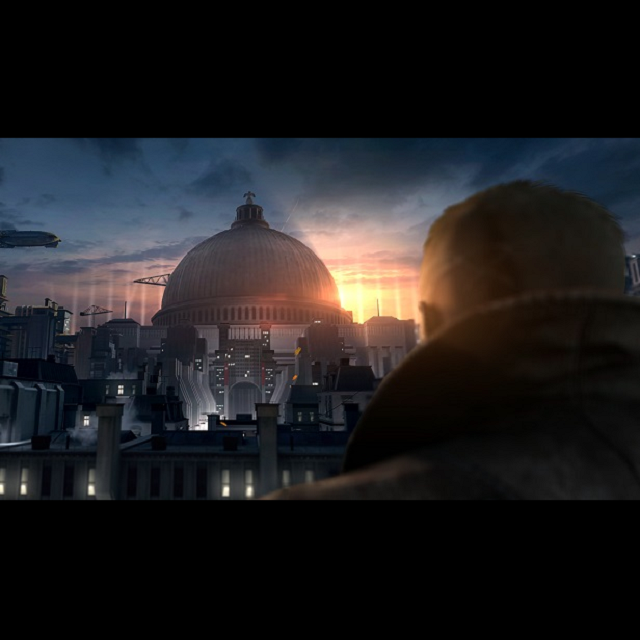
Fourteen years is a lifetime, and it made the ominous world-building a lot easier to take in. They say history is written by the victors, and the Third Reich didn't pull any stops in the New Order. This was heavily reflected upon on the game's portrayal of London, which has been torn down and rebuilt in the image of its new masters. Many of us who've had even a passing interest in world history would immediately recognize the looming feeling of oppression as Blazkowicz traversed the concrete landscape, adorned by the all too familiar red, black and gray color scheme of the enemy.

Perhaps most symbolic of this was the London Nautica, a massive research facility which served as a major setpiece and was deeply symbolic of the Reich whose unchallenged might threatened to sap the hope out of a subjugated free world.

The things I've seen in this life. Strange shit that churns your stomach. Turns your hair white. I've seen a thousand battles. I've seen the sun set on five different continents. I've seen dust rise off the surface of the moon. But all I want is to see you again.

Thus, hope was implied to be a scarce commodity in The New Order's world. Amidst the gore and the explosions, it's easy to miss the fact that the resistance (called the Kreisau Circle) was not attempting to topple the Reich but rather sought to merely take out a small part of it. They were more driven by a personal vendetta against Totenkopf, rather than good intentions, with most of everything else playing second fiddle.

With that being said, MachineGames provided ample commentary on the Nazi's ideologies. We are shown characters broken by the war, as well as unfortunate victims of their regime's crimes against humanity.

Set Roth, the Jewish scholar who was a member of the Da'at Yichud, summed it up pretty well. He said that human faith and reason should be accompanied by doubt when they seek enlightenment. He added that the Reich was the product of a society founded on the notion of absolute certainty and unquestioned conviction. He kept doubts in his beliefs and posited that if their situation was a test from the heavens, then humanity was failing gloriously.

I still wonder whether he was talking to the protagonist, or to us.

It's agony to dream like this and wake up to reality. Sometimes, true, it's good to remember what you're fighting for.

With everything said, I believe Wolfenstein: The New Order is not just an excellent game, but a rather gripping story told with memorable characters. The Second World War has been the subject of countless games for a very long time, and The New Order somehow manages to stand out above the rest without trying to enter an already bloated multiplayer market.

Twenty years, and Blazkowicz is alive and well.

Wednesday, June 11, 2014

Overthinking : Time Travel in Edge of Tomorrow

"Come find me when you wake up!"
- Rita Vrataski
 
Warning: Spoilers abound.

At first glance (and even in its trailers), Edge of Tomorrow seemed to be standard sci-fi fare - marines embedded into powered exoskeletons battling a hostile alien force known as the Mimics in a D-Day-like climactic battle.

William Cage is a former civilian who took up a job as an Army spokesman. Circumstances forced him to participate in the film's central battle, Operation Downfall, in an attempt to retake Europe in a battle reminiscent of World War Two's Invasion of Normandy. He refuses and tries to bribe his superior, leading to him being incapacitated and waking up some time later en route to the said battle.

Unsurprisingly, he is brutally killed after realising that the battle was for naught twenty minutes into the film but not before he kills one of the rarer strains of the creatures (called an Alpha).

He then wakes up, en route to the same battle.

Time travel is a difficult topic to encapsulate in a medium such as films, and very few manage to do it (such as Looper). This is mainly because past films had to deal with the consequences of causality - especially since characters in such stories did not have the privilege of immortality bestowed upon them.

Edge of Tomorrow tries to subvert two birds in one stone - time travel in their universe only worked backwards and it was triggered by death and (perhaps most importantly) was only controlled by one entity at a time.

Essentially, the enemy was led by an a brain-like creature dubbed the Omega, which had the ability to 'reset' time and learn from the tactics of the human forces, essentially allowing them to prepare for the invasion from past experience without it having ever taken place.

The fact that the power can be stolen was a product of extremely lucky circumstances. Alpha Mimics were one-in-three-million and were highly resilient in addition to their already formidable combat abilities. To have a career soldier, Rita, kill an Alpha is one thing but to have Cage kill another while essentially being served as cannon fodder must have been highly improbable. Needless to say, the Mimics try to get the power back in the one way that it could be done throughout the film - by exsanguination of the current holder of the ability.

As such movies tend to go, there are a couple of plot holes which got me thinking and I've been trying to reconcile them in my mind (as I tend to do).

Firstly, how were they able to pass on their ability to a non-mimic host? I'm guessing that the creatures are carbon-based which would have allow them to easily infect humans from their blood. This is lightly implied in the bar in London where war veterans ponder on the purpose of the Mimic's invasion of earth and settle on the theory that they sought to gather resources that are needed by Earth-like organisms.

Secondly, the ability isn't so much as time travel but instead was some sort of time anchor. Rita was lauded for her distinction (as the Angel of Verdun) of having killed hundreds of mimics at the Battle of Verdun - which was later revealed to have been due to the fact that she has fought that particular battle hundreds of times a the previous holder of the reset ability. Her last attempt resulted in an overwhelming victory for the UDF at the cost of losing the ability due to a blood transfusion due to injuries. This sets the premise that people are anchored to a very specific time period once they are imbued with the Alpha's blood, albeit we don't exactly know how such anchors are chosen.

Lastly, the cause for the resets to trigger doesn't exactly make sense from a narrative viewpoint at first glance. The Omega could have easily performed it immediately after Cage blew it up but was unable to which meant that, like humans, it may not have had complete control over its powers as well.

Another possible explanation (and one that makes a lot more viable) is that the reset actually occurs much later in the 'present' timeline. This makes sense when we take into consideration the fact that the Omega doesn't perform a reset immediately after an Alpha is killed even if it is telepathically aware of such - which may very well also explain why it wasn't able to reset the timeline after Cage was mortally wounded before killing the Omega.

This, of course, begs the question:

How lucky was William Cage to have been in the right place at the right time not once but twice?

The odds are approaching nil - and I guess that's why it's called a piece of science fiction. For the record, it's a really good one at that.

Wednesday, April 23, 2014

The Cave

The Seven
"I have a really interesting story to tell you this evening. So pay attention. It's a story of seven people and a glimpse into a dark place in each of their hearts.

But be careful before you judge, there is a dark place in your heart as well. Someday you will find yourself descending my depths in search of what you desire, and you might not like what you find either.

But enough about you. This is about them."
- The Cave

Friedrich Nietzsche once wrote that when one gazes into the abyss for long enough, they would find it staring back into them. Variations of this idea have resonated throughout a lot of mediums over the decades, from novels to comic books to movies that imply that a dark and terrible side exists within every person. I guess there must be some truth to this, given the popularity of a concept that is as old as mankind itself.

Such is the theme behind Ron Gilbert's The Cave, a platformer-puzzler set in a similar vein to another one of his oldest point-and-click adventure games - Maniac Mansion. The similarities, however, end at the genre because unlike his 1987 classic, The Cave is a dark comedy narrated by the titular Cave, a sentient being that claims to have the ability to show its explorers the deepest desires of their hearts.

From a pool of seven playable characters, with each one harboring their own personal motives for braving the ominous cavern, the player chooses a party of three per playthrough to enter the Cave and uncover its secrets. Together they must cooperatively traverse the labyrinthine depths of the Cave, lending their unique abilities to solve puzzles and defeat the trials set before them.

For a game with such alluring visuals, The Cave is a surprisingly dark game. Each one of the seven characters seem to have a sentence to serve for previous sins, and the supernatural caverns act as their purgatory (or in some cases, their personal hells). With the Cave being the sole narrator of the game, each character has a personal section that echoes the reasons for their journey. Furthermore, cave paintings are scattered throughout the playthrough which help flesh out each character's backstories, and I'd recommend finding them all to enhance what little, albeit effective, storytelling that the writers of the game have employed.

I highly recommend this game, most especially for its unusual stories. There is no moral ambiguity in this title. Instead, players are offered a glimpse straight into the dark side of humanity and are given the chance to reflect on what it may mean for themselves.

I got my copy via the Humble Mobile Bundle 5, which expires a week after this article is published. I'd recommend this method because Bundles are always worth it given the premium quality of the games that they offer (and you'll also help indie developers and charities to boot).

Otherwise, the game is also available on Google Play.

Wednesday, February 26, 2014

Injustice: Gods Among Us

Tie-in games have historically been an iffy bunch. Usually they just exist to milk the last cents out of the customer's money.

Injustice: Gods Among Us strives to be different, which is a pleasant surprise. As a tie-in game to the Playstation 3 and 4 titles of the same name, the mobile game serves as a light version of the fighting games.

Essentially, the mobile version is a card game wrapped in a three-versus-three fighting game shell. Players grind for credits which they can use to buy booster packs, with each one containing playable characters as well as cards that enhance their powers. The game borrows characters from all over the DC multiverse. Some of the more popular characters, like Batman and Superman, have several versions who possess different abilities and appearances.

Combat is simple and intuitive, with taps corresponding to light attacks while swipes generate heavier moves. Each character has three special moves, which deal a lot more damage and try to impress the player with flashy graphics. Luckily, this does not make the higher levels of the game trivial and boring. The AI isn't too smart, but it will punish players if they become too careless.

The game itself is massive (at over 1GB), but it goes without saying that the graphics are nothing short of fantastic for a free mobile title.

What makes the game worth playing is that the developers continually release challenges which allow players to collect otherwise new and unobtainable characters, like Scorpion (of Mortal Kombat fame) and Darkseid (who isn't available in the console versions). While the game has in-app purchases, nothing is hidden behind a paywall - players can earn everything with a reasonable amount of effort and have fun while doing it.

Unlocking goodies for the console version (and vice versa) is merely icing on the cake. If anything, the mobile game has made me want to the the console version.

Get Injustice: Gods among Us if it's something that interests you. It's available on Google Play and iOS.

Wednesday, January 22, 2014

Overthinking - Indie Game: The Movie

"My whole career has been me, trying to find new ways to communicate with people, because I desperately want to communicate with people, but I don't want the messy interaction of having to make friends and talk to people, because I probably don't like them."
- Edmund McMillen

I've had the pleasure of watching Indie Game: The Movie recently. It's a documentary that gives viewers an inside look on how indie games are made. What's interesting about the film was that it gave less attention to the technical aspects of the industry, but instead focused on showing the less visible aspects of development - the visions, struggles and personalities of the people behind the game. It focused on three massively popular games (namely Braid, Super Meat Boy and Fez) and how making games that the creators invested a great deal of personal effort into made it different from the games churned out by game studio giants and their mainstream titles.

I think it's painful to watch, and that's because it hit a little too close to home.

I think that this documentary should not only be watched by those in the gaming industry nor just by gamers themselves, but also anyone who has ever had (or still has) an interest in creating their own content, in whatever form it may be.

Seeing the sacrifices, heartbreak, depression and that finality of releasing their creation to the world is something that should remind us that the people behind the flashy things we take for granted are human just like us - and that their struggle to express and encapsulate their dreams into a tangible form for the rest world to enjoy is nothing short of superhuman.

I think each game's story had something to point out in the personal lives of each viewer - and in turn made it resonate on a personal level. Super Meat Boy's development story made me question what I've done to retain or even realize the far-cried dreams I've had when I was younger. Fez's story was a reflection of refusing to compromise one's vision for the expectations of others even in the face of ridicule and lack of confidence. Lastly, Braid's story was that of hope - that there is always someting of value to find if one keeps looking for it long enough.

Overall, it's a very interesting film. It's one of those things that should have no business in making one reflect on the personal workings of their own lives, but it gets the job done by invoking eerily relatable aspects of our personal lives.

Wednesday, January 15, 2014

Heroes of Dragon Age

Dragon Age is a franchise that has played its part in defining the high point of the past generation of games. While Dragon Age 2 came up short on so many levels, Origins paved the way for excellent games to follow in its wake, such as the Mass Effect series.

Due to some unfortunate events, I could somehow no longer install Blood Brothers on my Droid so I looked for an alternative and found Heroes of Dragon Age.

The game, unsurprisingly, is of similar concept to most of the card-collecting RPGs that seem to float around these days. I'm guessing that the game's main selling point is the fact that it rides on the coattails of the revered franchise and borrows characters from all over the Dragon Age universe.

As is often the case with these types of games, progression is notoriously difficult and is heavily dictated by purchasing packs of heroes. If there's one redeeming factor for the game, it's the fact that players have a chance (even if it is miniscule) to obtain even the rarest of units - without exceptions - if they embrace the grind. In-app purchases exist to serve as shortcuts for those with more dispensable income, but aren't required for the most part.

With regards to gameplay, Heroes of Dragon Age seems to still be on its early stages. Quests and PvP fights could be performed to obtain gold as well as experience, and both of these activities are limited by the amount of energy and stamina that the player accumulates. Typical gameplay lasts for ten to fifteen minutes on average, with around two hours to wait while they replenish. Barebones as it is, I think the game holds a lot of potential given the experience of its backers - although it's EA, so don't be surprised of any strange behaviour.

Heroes of Dragon Age is available for both Android and iOS. Give it a try if the series is your cup of tea. With Dragon Age: Inquisition coming out soon, I'm guessing it's best to start playing early.

Wednesday, January 08, 2014

Quadropus Rampage

I have a tenuous relationship with roguelike games. As a matter of fact, I've only played a couple to completion - Azure Dreams (which was relatively easy due to being built for the Gameboy Color, a kid-friendly system) and Shiren the Wanderer - which I barely beat before ragequitting out of sheer frustration (and loss of equipment earned over hours of play).

Hence, I didn't expect Quadropus Rampage to be anything much. After all, it's a free game for the Android platform from a relatively unknown developer.

It's amazing to see what people can do when they care about the game first and think about profits as a distant afterthought.

Quadropous Rampage is a roguelike brawler that features Tack (a four limbed octopus who wields things like tennis rackets and chopsticks) and his pet starfish Bingo as they try to make their way into the deep abyss against hordes of creatures to defeat Pete, the God of the Sea. It goes without saying that the deeper Tack dives, the more difficult things are and it is inevitable for him to meet his demise at some point. Luckily, upgrades are available for orbs collected by slaying enemies - and they can be used to upgrade different abilities like speed and special moves as well as purchase additional pets to aid him in his quest.

While it may sound relatively simple, there are a few other things to keep in mind that would help turn the tide to Tack's advantage (since the game becomes really difficult at some points). Masteries are tasks that are completed over the course of gameplay, and achieving them grants access to one of two available perks with provide changes to how the hero fights the creatures of the deep. Artifacts, which grant even more abilities to those who manage to acquire them, can be bought from the game's vendor (whose name I forget) or found randomly during the journey.

There's an awful lot to do, and four different game modes would keep even most players occupied. In-app purchases exist to help in gaining access to the unlockables (which could be obtained by regular gameplay. Personally, I don't mind the grind to earn them, as it definitely helps to hone the finer points of battle - and shortcuts in games like these would only go so far.

This shouldn't be free, but it is - and it's awesome. Get Quadropus Rampage from Google Play now!

Wednesday, December 18, 2013

Ender's Game

"In the moment when I truly understand my enemy, understand him well enough to defeat him, then in that very moment I also love him."
- Andrew "Ender" Wiggin, Ender's Game

Ender's Game is a science fiction film based on the novel of the same name by Orson Scott Card. Set in the far future, it tells the story of humanity fifty years after a brutal interstellar war with an alien race called the Formics, bug-like creatures capable of spaceflight and advanced electric-based warfare. After a narrow victory by a hero named Mazer Rackham, humanity struggles to rebuild and prepare itself for the return of their sworn enemies. Children are enlisted in battle school, where their talents are honed for the upcoming war.

Personally, I'm still quite unsure on how to rate the film. Obviously, I like the material and all its premises - where the Earth leadership use the innate adaptability of youth against a similarly unpredictable enemy without regard for its consequences. On the other hand, a lot of the backstory from the book was merely hinted at in the film - the machinations set forth by his sociopathic brother, the influential essays by both of Ender's siblings that led to a shift in Earth's leadership and the direct results of Ender's actions that would eventually lead to the legend of The Xenocide. The ending felt dry as well, and I could not decide whether it seemed a little rushed or if they had a hard time trying to add a persona to the Formics after two hours of being portrayed as a species hellbent on instinctive conquest.

It's one of those cases where the book provides too much material to squeeze into two hours' worth of footage. I understand that a whole lot of the plot is driven by dialogue, but a lot of the finer details have been skipped to the point where we are left to wonder about the motivations of some of the characters after they leave the screen. Ender's Game falls in that strange space occupied by novel adaptations like Paul Verhoeven's Starship Troopers and Zack Snyder's Watchmen.

It could have been more, but I can't say I didn't like what I got.

Wednesday, October 16, 2013

Star Command

Space RPGs are few and far in between. The closest thing to perfection that I could name off the top of my head is the space epic Infinite Space for the Nintendo DS.

While anyone would be hard-pressed to match that game, Warbird's Star Command would like to show off its potential - albeit on the more mobile OS platforms. I've had the chance to play a copy for the Android version and it didn't disappoint.

Starting off as a Kickstarter project twice, Star Command is a space simulation game. Think of it as a cross between Star Trek and The Sims, where you micromanage a crew of a starship to accomplish missions and generally survive the harsh darkness of space.

Players have a choice between a few ships and go on to build rooms within them, which in turn grant various capabilities for the ship such as weaponry, shielding and dodging ability. Crew members are then hired and assigned to each room, granting them some sort of proficiency which would help the entire crew survive the journey. The game is mostly story-driven, although players can farm resources - called tokens - to further upgrade their ships.

As someone who hasn't followed the drama behind the creation of the game (and I'll leave that for the reader to look it up), there are a just a couple of gripes I have about this game. First off, the game isn't that long. Around thirteen missions and a couple or so side quests is all the players get, and a lot of the planets seem to still be locked for some reason. Secondly, the controls are not well-refined. While this isn't a problem in other games, space battles in Star Command can be ridiculously hectic as there are often battles on two fronts and players would often have to scramble their crew between manning the different rooms, repairing and healing other crew and repelling invaders to are teleported onto the ship.

Star Command is available on Google Play for around three dollars. Fair warning though - while it's very good at what it does, it mostly seems like an unfinished game. If it's your cup of tea, have a go at it.

Wednesday, October 09, 2013

Dungeon Quest

Battlemages are the best.
Like many people I know, I've spent an unhealthy amount of time playing Diablo II when I was younger. I've probably spent several hundred hours on my zoomancer, the aptly named Dralnu (which in itself is another reference to a nerdtastic childhood). Not my proudest moments, I know. I've been playing Diablo clones on most platforms I could get hands on for as long as I remember, and Android is no exception.

I came across Dungeon Quest completely by accident and despite the unflattering screenshots, I gave it a shot based on the very good reviews.

Needless to say, I wasn't disappointed. Dungeon Quest is essentially a barebones Diablo clone, which isn't necessarily a bad thing. Lacking a story (at this time), it features the a very effective randomized item system, tiered enemies, and a very interesting character building system, which allows players to highly customize their builds while at the same time allow cookie cutter builds in the lower levels.

Level-ups are very straightforward - characters are given skill points to spend on either attack power, hit points and mana points while skill trees are non-existent. Instead, active skills are derived from the mainhand and offhand equipment while passive skills are acquired as built-in bonuses from other gear as well as from random item affixes.

There are two character classes at this time, the mage and the warrior. It's worth noting that while there are only two classes, the game encourages players to play them according to personal preference. For instance, no two mages are the same - one person could have a summoner that could fire explosive balls of energy while another could have a sword-wielding mage that teleports around the battlefield to avoid danger (which is how I built mine).

The best part, however, is that it's completely free - although it has ads in it (which are not too obtrusive and can be very cheaply removed by any in-game real currency purchase).

I definitely recommend giving Dungeon Quest a try. Get it now on Google Play here.

Wednesday, September 11, 2013

Darths & Droids

+500 XP.
"If movies were made by gamers, all the heroes would be short, overweight guys with physical disabilities." 
- Episode 52 annotation (Darths & Droids)

I've been on a bit of a Star Wars binge lately, mainly due to a book I'm reading as well an awesome find - a webcomic called Darths & Droids.

In a nutshell, Darths & Droids is a humorous take on the six official films - where each one is played out as a pen and paper roleplaying game amongst a singular gaming group (hence the obvious homage from title's initials).

Each panel mostly consists of stills from the movies interspersed with witty dialogue from the players and the game master. While many exchanges have the expected in-character roleplaying fare, the majority consists of conversations amongst the gaming group - in the form of gamer bickering, rules lawyering (in a good way), narrative justifications along with the occasional interpersonal quarrels and other real world woes.

However, it's quite important to note that the webcomic uses roleplaying-centric terminology which the creators have helpfully annotated with (hopefully) layman's terms at the bottom of each strip. Prepare for a lot of background reading on TV Tropes for the uninitiated.

All in all, Darths & Droids is a very interesting webcomic that grants readers an inside look at a fairly geeky (and sometimes esoteric) hobby and it provides a refreshingly unique take on the Star Wars universe.

Wednesday, June 26, 2013

Overthinking : The Last of Us

Serene moments such as this are rare and a welcome breather.
"Swear to me. Swear to me that everything you said about the Fireflies is true."
"I swear."
"Okay."
- Ellie to Joel, The Last of Us (Epilogue)

Post-apocalyptic videogames are a dime a dozen these days. A vast majority of them (and I'm looking at you, Left 4 Dead) place a higher emphasis on the action over storytelling. After all, everyone secretly wants a zombie apocalypse. It's hard to concentrate on a well-written narrative when you're surrounded by thousands of mindless undead looking for food.

Naughty Dog's last game for the Playstation 3, The Last of Us, begs to differ. I never thought it would be possible for something of this genre to be compelling without bringing too much drama to the table, but this game succeeds - and is a worthy swan song for the seventh generation of video game consoles.

In a nutshell, The Last of Us is a story set in a world that is twenty years into an apocalypse brought about by the mutation of the cordyceps fungi (rendering it capable of infecting human hosts). Joel, a smuggler harboring a painful past due to the brutal loss of his daughter during the outbreak's early days, finds himself tasked to deliver the most unusual cargo in the form of the fourteen year-old Ellie - a young girl who appears to be immune to the virus and may hold the key to a long sought after vaccine.

Together they must travel westward from Boston to Colorado and eventually Utah, where a group calling themselves the Fireflies hopes to manufacture the cure. Along the way they are beset not only by the elements but also by the infected and Hunters - people who chose to stay outside the relatively safe (but harshly governed) quarantine zones and instead live on the outside despite the danger.

It's important to note that the game rarely pits Joel and Ellie against hordes of infected and bandits. On the contrary, a lot of the more memorable scenes feature the lonely desolation of their surroundings and nature's eventual reclamation of a world no longer ruled by humanity.

The Last of Us, like a lot of media which feature the breakdown of society due to some outbreak (zombies or otherwise), has tabula rasa as an over-arcing theme. It's a sad pondering of a different kind of clean slate which raises the question - how would people act when the constraints of society are suddenly removed and they are able to act without consequence?

Even more important than this, however, is the fact that The Last of Us is a bildungsroman of sorts - not just for Ellie but also for the grizzled Joel. Their adventure isn't the conventional coming-of-age story as well, although there is no lack of such, but also of the growth of their relationship - one that starts from being apathetic strangers (where Ellie is just another shipment) and ends with one that I could say is as good as a father-daughter bond. This is highly emphasized in the ending where Joel chose to save Ellie's life over the chance for a cure (and humanity's resurgence).

It's a bittersweet conclusion, but it doesn't lean on the negatives too much. On one hand the Fireflies' cause, noble as it may seem, is effectively ruined with the death of their leader and the escape of the cure. On the other a young girl's life is spared from death, even if it was for a desperate cause, and she is given the chance to live a full life with people who won't abandon her (or die). It's certainly easy to justify Joel's actions, especially since their world has already gone to hell anyway and many of the people left are either spending their lives in relative safety or bandits who have eschewed any semblance of morality, choosing to live savage lives amongst the infected.

Overall, The Last of Us is more than a game. It is a strong example of the long-standing (but still unaccepted) notion that video games are as powerful as storytelling mediums as any good book and tries to make a case that they should be seen in a new light - as pieces of art.

Wednesday, May 22, 2013

Into Darkness, Memes and Other Things

"At great cost, yes."
- Spock Prime

Be warned, spoilers abound.

So we caught Star Trek: Into Darkness last weekend. I'm not exactly what someone would call a Trekkie, nor can I speak Klingon, but Star Trek has been around for so long that anyone who's been running all over the Internet is bound to have seen something connected to the franchise.

I want to get the one single annoyance out of the way first - JJ Abram's signature lens flares. There are lens flares everywhere, even indoors, in low light conditions. It isn't too bothersome in itself, but the fact that using it in a lot of scenes full of dialogue makes the scenes a bit too artificial, especially when the audience is supposed to concentrate on what the characters have to say. As Simon Pegg so eloquently said it, it's understandable that Abrams may have wanted the pseudo-documentary feel of raw, unedited footage - which quite frankly doesn't work very well in a science fiction film set in the far future. Figure that out.

Anyway, if one was familiar with the infamous Khan scream (from the Wrath of Khan movie) meme, you're in for a treat. Abram's Star Trek series is a reboot set in somewhat the same continuity (hence the existence of Leonard Nimoy's Spock Prime) and how they paid homage to that scene is quite funny - even if the scene wasn't supposed to be funny.

Speaking of Khan, I liked how cold the character was portrayed and it reminded me of how Alan Rickman portrayed Snape in the Harry Potter films - even if he wasn't exactly of the same origin as the original Khan.

Perhaps one last thing I wanted to point out was that the original Kirk, played by William Shatner, was written to be a womanizer of sorts. It was often joked that he slept with all manner of aliens, especially the infamous green alien woman - referring to the Orion slave girl - hence, the scene where he wakes up with those cat people, among others. And yes, all these one can learn if they've been on the Internet for long enough.

Jeez, I'm old.